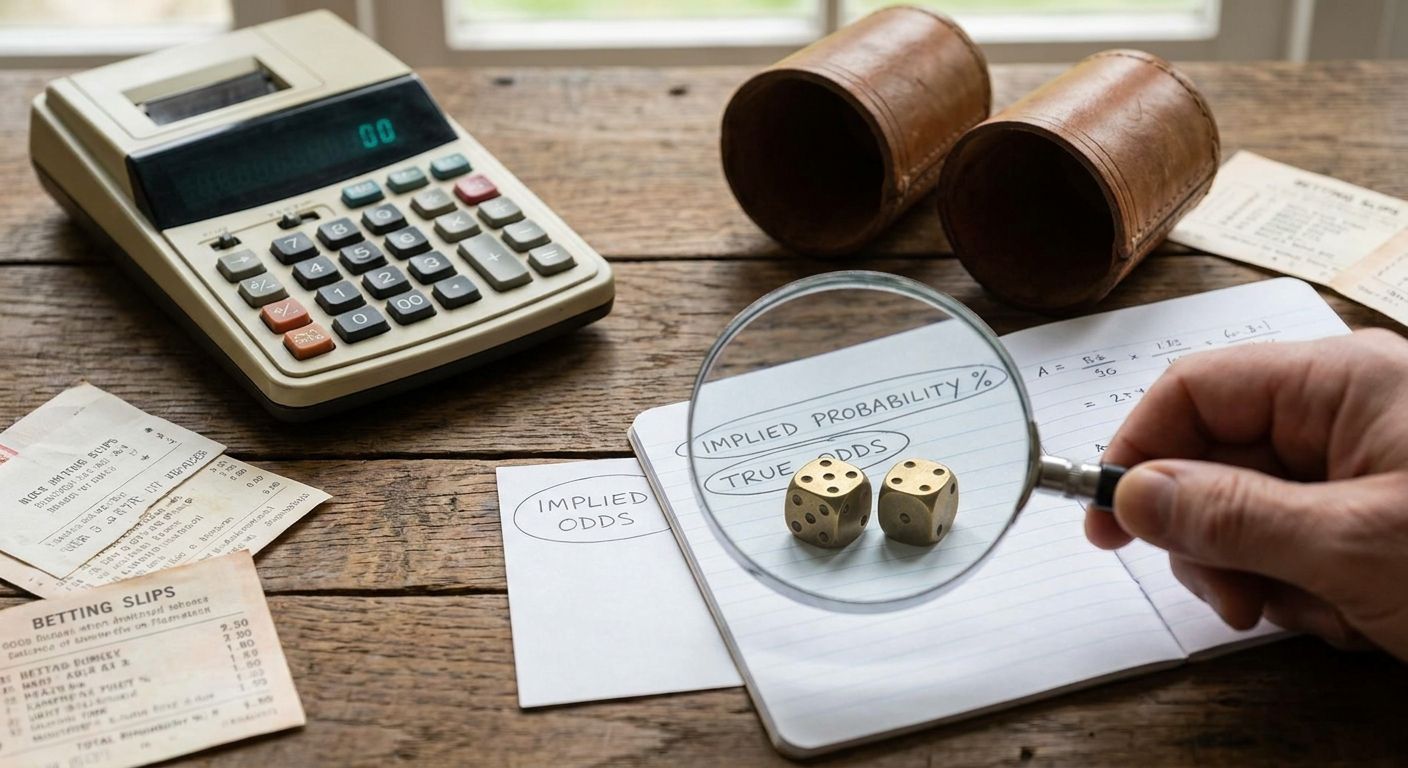
American odds implied probability comes from two formulas: for favorites (negative odds), divide the absolute value of the odds by itself plus 100; for underdogs (positive odds), divide 100 by the odds plus 100. A -150 favorite implies 60% probability, and a +150 underdog implies 40% — but neither number accounts for the sportsbook's vig, so the real edge is smaller than the raw math suggests.
- Negative odds formula: absolute odds divided by absolute odds plus 100 — a -150 favorite implies 60% probability.
- Positive odds formula: 100 divided by odds plus 100 — a +150 underdog implies 40% probability.
- Standard -110 lines imply 52.38% per side, which sums to over 100% because of the vig.
- American odds implied probability is the starting point for spotting +EV bets, not the final answer.
- Removing the vig with a no-vig calculator gets you closer to true probability before you bet.
Why This Matters
Every American odds number sportsbooks post is a probability estimate dressed up as a payout. If you can't convert -150 or +180 into a percentage in your head, you can't tell whether a line is fair, inflated, or worth betting.
Books build in a margin — the vig — so the implied probabilities on both sides of a bet always add up to more than 100%. Ignoring that gap is the most common mistake recreational bettors make, and it's the first thing serious +EV betting tools correct for automatically in 2026.
How Do You Convert American Odds to Implied Probability?
The conversion depends on whether the odds are negative or positive.
Steps for negative odds (favorites):
- Take the absolute value of the odds (drop the minus sign).
- Add 100 to that number.
- Divide the original absolute value by the sum.
- Multiply by 100 to get a percentage.
Steps for positive odds (underdogs):
- Add 100 to the odds.
- Divide 100 by that sum.
- Multiply by 100 to get a percentage.
Here's how common lines shake out:
| American Odds | Calculation | Implied Probability |
|---|---|---|
| -200 | 200 / 300 | 66.67% |
| -150 | 150 / 250 | 60.00% |
| -110 | 110 / 210 | 52.38% |
| +100 | 100 / 200 | 50.00% |
| +150 | 100 / 250 | 40.00% |
| +200 | 100 / 300 | 33.33% |
Notice that -110 doesn't land on a clean 50% — that gap above even money is the vig, and it's baked into nearly every point spread and total priced in 2026.
Negative Odds (Favorites): -150 Equals 60% Implied Probability
A -150 favorite means you'd risk $150 to win $100. The formula converts that risk into the win rate the book's price demands: 150 divided by 250 equals 0.60, or 60%.
That 60% figure reflects break-even math on the book's number, not the team's actual chance of winning. If your own model puts the true probability at 65%, the -150 line carries positive expected value — a read worth confirming with a no-vig calculator before you place the bet.
Verdict: -150 implies 60% — bet it only when your own probability estimate clears that number.
Positive Odds (Underdogs): +150 Equals 40% Implied Probability
A +150 underdog pays $150 on a $100 stake. Run the formula and 100 divided by 250 gives 0.40, or 40% implied probability — the book is pricing this side to win roughly 2 out of every 5 times.
Underdog value shows up often in American odds implied probability work because public money skews lines toward favorites. Line shopping before locking in a number matters more here than on any other bet type, which is what odds comparison sites exist to speed up.
Verdict: +150 implies 40% — take it only if no competing book offers a longer price on the same side.
“If a -110 line's implied probability doesn't drop close to 50% after you remove the vig, the book is pricing in an edge you haven't found yet.”
Why Implied Probabilities Don't Add Up to 100%
Add the implied probabilities on both sides of any two-way market and you'll almost never get exactly 100%. What drives the gap:
- The vig (juice): books price both sides above fair value so the combined probability exceeds 100%, guaranteeing margin regardless of outcome.
- Market type: a standard -110/-110 spread sums to 104.76%, while lopsided moneylines often run wider.
- Book-specific pricing: each sportsbook sets its own margin, so the same game shows different implied probabilities at different books.
- Live in-play markets: vig widens during a game because books re-price faster than bettors can react.
- Public betting pressure: heavy action on a popular side pushes implied probability further from a model's true number.
- Market liquidity: player props and alt lines typically carry higher vig than main lines.
What's the Difference Between Implied Probability and True Probability?
Implied probability is the percentage baked into a sportsbook's posted odds; true probability is your own estimate of how likely the outcome actually is, stripped of the book's margin. The gap between the two is where +EV bets live — if your estimate beats the book's implied number by a meaningful margin, the bet carries positive expected value in 2026 just as it did in prior seasons.
How Do You Remove the Vig from Implied Probability?
You remove the vig by adding both sides' implied probabilities, then dividing each side by that total to normalize back to 100%. On a -110/-110 market where each side implies 52.38%, the total is 104.76%; dividing 52.38 by 104.76 returns each side to a true 50% — the calculation a no-vig tool runs automatically instead of by hand.
What Win Rate Do You Need to Break Even at -110?
Betting -110 requires winning 52.38% of the time to break even, because that's the implied probability the price converts to. Finish below 52.38% long-run and the vig drains the bankroll even when you're picking a respectable share of winners.
Measuring your real win rate against that 52.38% line across a full season is the clearest signal of whether your process works — the kind of check a bet tracker app handles across every wager. VigWatch builds implied probability and no-vig math into its odds comparison tools, so you're not running the formula manually on every line.
Size bets off real probabilities
Compare no-vig probability against your bankroll before placing a bet.
FAQ
How do you convert American odds to implied probability?
For negative odds, divide the absolute value by itself plus 100; for positive odds, divide 100 by the odds plus 100. A -150 favorite implies 60% and a +150 underdog implies 40%.
What does -110 mean in implied probability?
A -110 line implies 52.38% probability. That's why you need to win more than half your bets at standard vig just to break even.
Why do implied probabilities not add up to 100%?
Sportsbooks build a margin into both sides of a market, so combined implied probability on a standard -110/-110 line reaches 104.76% instead of exactly 100%.
Is implied probability the same as true probability?
No. Implied probability comes straight from posted odds and includes the book's margin, while true probability is your own vig-free estimate of the outcome.
How do you calculate implied probability for +200 odds?
Divide 100 by 300, which gives 33.33% implied probability for a +200 underdog. The same formula applies to every positive American price.
What American odds equal a coin flip?
Even odds of +100 or -100 both equal exactly 50% implied probability, the closest American odds get to a true coin flip.
Do all sportsbooks show the same implied probability for a game?
No. Each book sets its own margin, so the same matchup can convert to different implied probabilities depending on where you check the line.
How does implied probability help find +EV bets?
An edge exists when your true probability estimate is higher than the book's implied probability on the same side. The wider that gap, the stronger the +EV signal.
One Last Thing
The 52.38% breakeven at -110 is easy to memorize, but it moves the second you shop a different price — -105 drops breakeven to 51.22%, and that 1.16-point difference compounds across a 2026 season faster than any single handicapping tweak.